Grab the worksheet that you created yesterday with the list of all credit card and loan accounts. Choose one account to focus on paying off at a time. Let’s say you have three credit card accounts, choose either the account with the highest interest rate or the smallest balance to get the momentum started. For example, using the list below:
Card / Loan
Balance
InterestRate%
Minimum Payment
Actual Payment
Macy’s
$1,500
25.74%
$60
$70
Chase Visa
$6,500
18.24%
$260
$280
Best Buy
$1,500
25.24%
$60
$90
Macy’s would be the account to focus on first (highest interest rate, lowest balance). Make the minimum payment to Chase and Best Buy and pay the minimum plus as much extra as possible to Macy’s.
Paying off one account at a time will get the momentum started! Tomorrow we will dig into how to create the snowball effect.
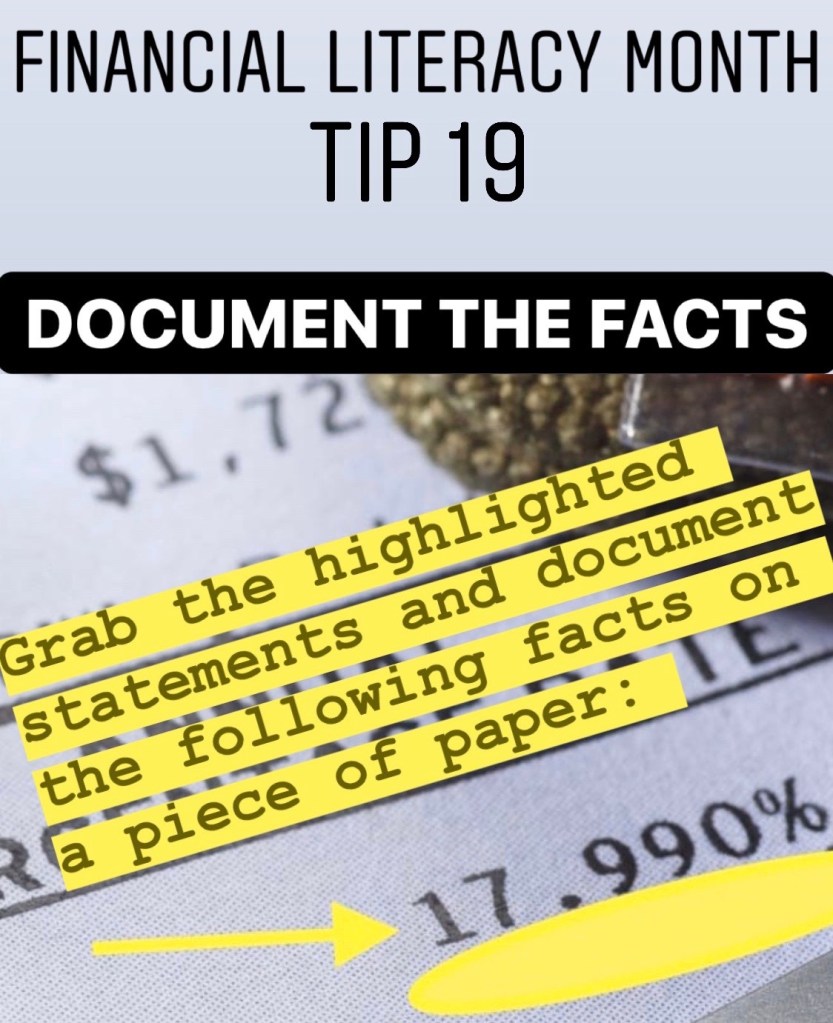
The last few tips have been to gather statements, highlight interest rates, call creditors to negotiate lower rates and now it is time to document the facts.
Grab a piece of paper and write down the following:
Account name (e.g., Chase Visa, Macy’s, Target, etc)
Balance
Interest Rate
Minimum Payment
Actual Payment
Knowing where you stand with overall payments will help build a budget and eliminate costly credit one creditor at a time.
Yesterday’s tip was to highlight the interest rate on all credit card / loan payment statements. Grab the stack of statements, call each credit card company and negotiate a lower interest rate. If an account is in good standing, creditors will often lower the rate to maintain the relationship.
A lower interest rate can reduce the payment, improve monthly cash flow and save you thousands in interest. Keep your statements handy, more to follow tomorrow!
In this time of economic uncertainty, it is important to review the interest rate(s) on all recurring statements. Knowing the interest rate(s) you are paying to carry debt will provide the evidence needed to craft a plan to eliminate costly debt. The first step in crafting the plan, is gathering the evidence.
Take the time to gather all credit card, auto loan, mortgage and personal loan statements. For each statement, highlight the following items:
Interest rate
Balance
Minimum payment
This tip will take 15 minutes to complete and will be used to complete tomorrow’s tip! Let the investigation begin……….
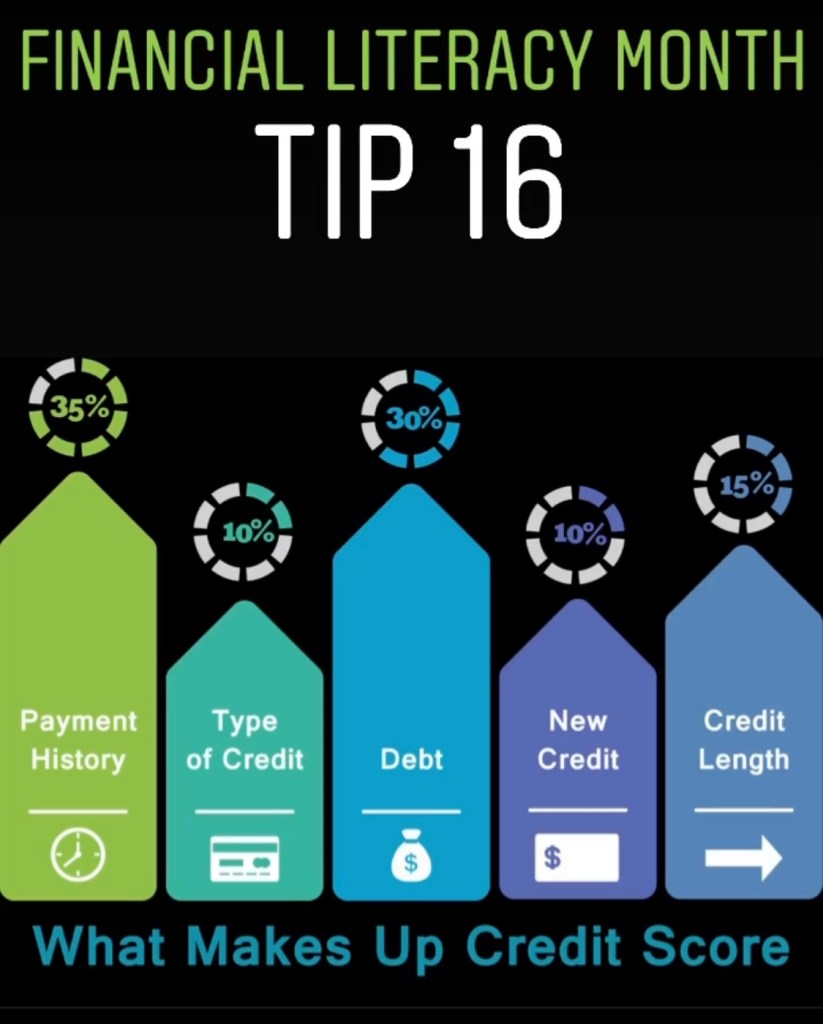
A credit score is like a financial GPA. Credit scores tell lenders how credit has been managed in the past. A higher score suggests less risk, a lower score suggests more risk. Knowing the factors that influence a score can help you maintain or even increase scores. Here is a quick breakdown of each factor:
Payment History – 35% of a FICO score is based on payment history with all accounts (e.g., loans, credit cards, student loans, etc.). On-time payments increase the score, late payments decrease the score.
Type of Credit – 10% of a score is based on having a variety of accounts such as credit cards, auto loans, mortgage loans and retail accounts.
Debt – 30% of a score is based on how much you owe on each account. Keeping the ratio of debt to available credit low will increase the credit score. For example, if a credit card has a $10,000 limit, keep the balance at or below $3,000 (or 30%). If balances are near the limit, a lender may view this as high risk and the credit score will decrease.
New Credit – 10% of the score is based on new accounts opened in the last 60-90 days, new applications and inquires to credit. It is important to note, opening too many new accounts or having a large number of inquiries can negatively impact a credit score.
Credit Length- 15% of the credit score is based on the length of credit history. The longer the credit history, the better. Try to avoid closing accounts that have a lengthy credit history (even if you don’t use them).
Obtain a copy of your credit at http://www.annualcreditreport.com, review your credit history using the above factors and make any changes necessary to improve your financial GPA aka credit score.



 Jodee Brydges | Author . Speaker . Coach